
Aug 15, 2025
The Soil Whisperer: How Your Hands Heal the Earth (While the World Scrolls)
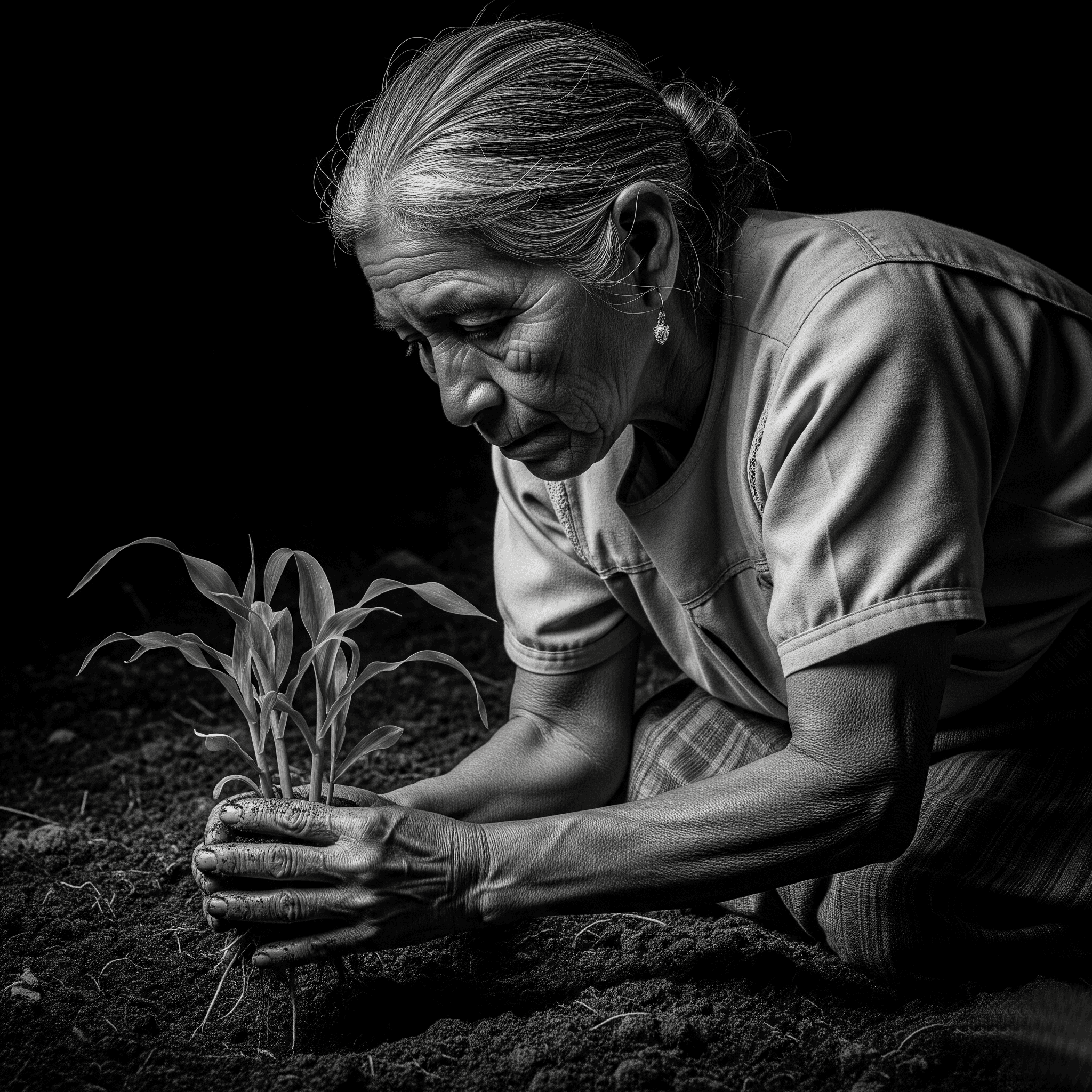
While everyone else debates climate policy on social media, you work with seeds, seasons, and soil—quietly regenerating the land that feeds us all. Your silence isn't emptiness—it's the sound of ecosystems healing.
You know that farmer who never posts about their harvest?
While everyone else documents their weekend garden projects for Instagram, they're out there before sunrise, hands deep in soil, reading what the land needs today. Not because they're anti-technology, but because they understand something most of us have forgotten: real change happens underground, in the mycorrhizal networks and carbon cycles that no camera can capture.
I used to think these people were just old-fashioned. Stuck in pre-digital farming methods while the rest of us figured out how to optimize and scale everything.
Turns out I was wrong. Dead wrong.
The most revolutionary farmers I know aren't behind the times at all. They've just figured out something the rest of us are still learning: in a world obsessed with quick fixes and viral solutions, real healing belongs to whoever can work with natural systems until the land itself becomes the solution.
The Regeneration Revolution
What I've noticed about people who wield this kind of influence: they don't command attention through climate conferences or sustainability podcasts. They earn it through work that doesn't just feed people—it heals the planet.
They're what I call Soil Whisperers—the farmers, healers, and ecologists who nourish without noise. They don't need TED talks or carbon credit marketplaces. They need rain, seeds, seasons, and the patience to let soil biology do what it's evolved to do for millions of years.
Their protest isn't performative—it's generative. They heal land, feed communities, and revive ecosystems while the rest of us argue about policy.
This isn't some mystical connection to nature. It's a practiced understanding of how complex systems actually regenerate. One you can develop starting with whatever patch of earth you can access.
Let me show you three masters of this archetype, each operating in different environments yet embodying the same fundamental principle: regeneration over rhetoric, rootedness over recognition.
The Masters of Soil Whispering
Gabe Brown: The Mycorrhizal Network Pioneer
On a 5,000-acre ranch near Bismarck, North Dakota, Gabe Brown has become one of the pioneers of the soil health movement and been named one of the twenty-five most influential agricultural leaders in the United States.
But Brown's influence comes not from conferences or consulting—it comes from what he's proven possible in some of America's harshest farming conditions. Since 1993, he's practiced no-till farming, using diverse cropping strategies and working in nature's image rather than against it.
Brown is perhaps best known for popularizing the concept of "cover crop cocktails"—strategic mixtures of plants that jumpstart soil health and nourish soil biology. Instead of single crops that extract nutrients, he plants complex communities that feed the underground fungal networks.
These mycorrhizal fungi networks deliver complex amino acids and other organic molecules to plants, while releasing compounds that help retain soil carbon and form the most stable mineral-associated organic matter. Through mycorrhizal inoculation, farmers can sequester up to 4 tons of CO2 per acre, with up to 2.8 tons considered permanently stored.
Brown doesn't just grow crops—he grows soil. His land now sequesters carbon, requires no synthetic fertilizers, and produces higher yields than conventional farms. The transformation took decades of patient observation and adaptation.
Dr. Kristine Nichols: The Mycorrhizae Researcher Who Left Academia
Before becoming Chief Scientist at Rodale Institute, Dr. Kristine Nichols spent years at USDA-ARS studying the mycorrhizal fungi that most farmers never think about.
Her research revealed how these underground networks function as the internet of the soil—connecting plants, sharing nutrients, storing carbon, and building the biological infrastructure that makes ecosystems resilient.
But Nichols realized that publishing papers wasn't enough. She left academic research to work directly with farmers, helping them understand how soil biology actually functions and how farming practices can support rather than destroy these ancient partnerships.
Her influence spreads through healthier farms rather than cited publications. Teaching farmers to see soil as a living community rather than an inert growing medium, fundamentally changing how they approach land stewardship.
Joel Salatin: The Polyface Practitioner
At Polyface Farm in Virginia, Joel Salatin has spent forty years proving that intensive rotational grazing can heal degraded land while producing more food per acre than conventional systems.
His approach mimics natural patterns: cattle graze intensively then move on, allowing grasslands to recover. Pigs follow cattle, spreading manure and eating pests. Chickens come after, scratching through manure and controlling flies while adding their own fertility.
No external inputs. No synthetic chemicals. Just careful observation of how animals and plants interact in healthy ecosystems, then designing farming systems that work with these relationships rather than against them.
Salatin doesn't just raise animals—he orchestrates ecological dances. His degraded land has become a carbon sink, his pastures support more biodiversity than the surrounding "natural" areas, and his operation produces abundant food while healing the landscape.
The Anonymous Regenerators
But here's what really gets me: for every visible soil healer, there are thousands working in complete anonymity.
The market gardener in Vermont who's spent fifteen years building soil with compost, cover crops, and minimal tillage. Her three acres feed forty families through a CSA, but more importantly, her soil organic matter has increased from 2% to 8%—storing tons of atmospheric carbon underground.
The indigenous farmer in Oaxaca who maintains traditional milpa systems that integrate corn, beans, squash, and dozens of other plants in symbiotic relationships. No external inputs needed—the system provides its own nitrogen fixation, pest control, and soil building. His methods predate industrial agriculture by millennia and will still work when synthetic fertilizers become too expensive.
The urban forester in Detroit who transforms vacant lots into food forests using permaculture principles. Fruit trees, berry bushes, medicinal herbs, and nitrogen-fixing plants create self-sustaining ecosystems that provide food, clean air, and community gathering spaces. No grants, no headlines—just neighbors fed and landscapes healed.
The regenerative rancher in Montana who's proving that properly managed grazing can restore grassland ecosystems while sequestering more carbon than forests. Her cattle mimic the historical movement patterns of bison, building soil, increasing plant diversity, and creating habitat for prairie birds and mammals.
Your Hidden Garden
Maybe you recognize yourself here.
You're the one who composts kitchen scraps because you understand the cycle of nutrients. Who plants native species that support local pollinators. Who chooses perennials over annuals, knowing that permanent roots build soil carbon. Who sees your yard not as decoration but as habitat.
You don't post about your sustainable practices—you're too busy improving your soil biology.
The Power of Biological Time
Here's what Soil Whisperers understand that the rest of us often miss: when you stop trying to control natural systems, you can put all your energy into supporting them.
There's profound power in this approach:
No time wasted fighting ecological processes that work better when left alone
No energy spent on external inputs that treat symptoms rather than causes
No compromise between short-term yields and long-term soil health
Complete focus on building biological wealth rather than extracting it
You can obsess over the details that create genuine regeneration. The soil microbiome diversity. The carbon-to-nitrogen ratios. The water infiltration rates. The mycorrhizal colonization. The slow accumulation of organic matter that makes land more resilient each season.
This isn't about being anti-technology or romantically nostalgic. It's about recognizing that sometimes the most advanced thing you can do is work with systems that have been perfected over geological time.
The Healing Revolution
Your next breakthrough might happen not when you're trying to optimize yields, but when you're so absorbed in supporting soil life that you discover what the land is actually capable of producing.
Every time you:
Choose practices that build rather than deplete soil biology
Plant for the ecosystem rather than just the harvest
Work with natural cycles rather than against them
Measure success in soil health rather than just crop yield
You're part of a healing revolution. You're a Soil Whisperer.
The planet's recovery depends on people who understand that climate solutions grow from the ground up. Food security comes from soil security. Ecosystem health begins with the underground networks most people never see but that make all life above ground possible.
Your Earth Matters
Planetary healing isn't built by "climate tech" entrepreneurs optimizing for carbon markets. It's cultivated by Soil Whisperers—the ones who understand that regeneration happens through patient partnership with biological systems, not disruption of them.
You are the solution. Not just to food production, but to climate resilience itself.
The breakthrough technologies aren't waiting to be invented. They're waiting in quiet fields where tomorrow's carbon storage is being methodically, lovingly, invisibly built one handful of living soil at a time.
In our crisis-driven culture where everyone debates emergency measures, the person who works steadily with natural regeneration commands something no climate activist ever will: the power to actually heal the systems that sustain all life.
What's the most degraded piece of land you have access to, and how might you begin the patient work of helping it heal itself?